Wireless Alarm Systems: What Property Owners Should Know Before Going Wire-Free
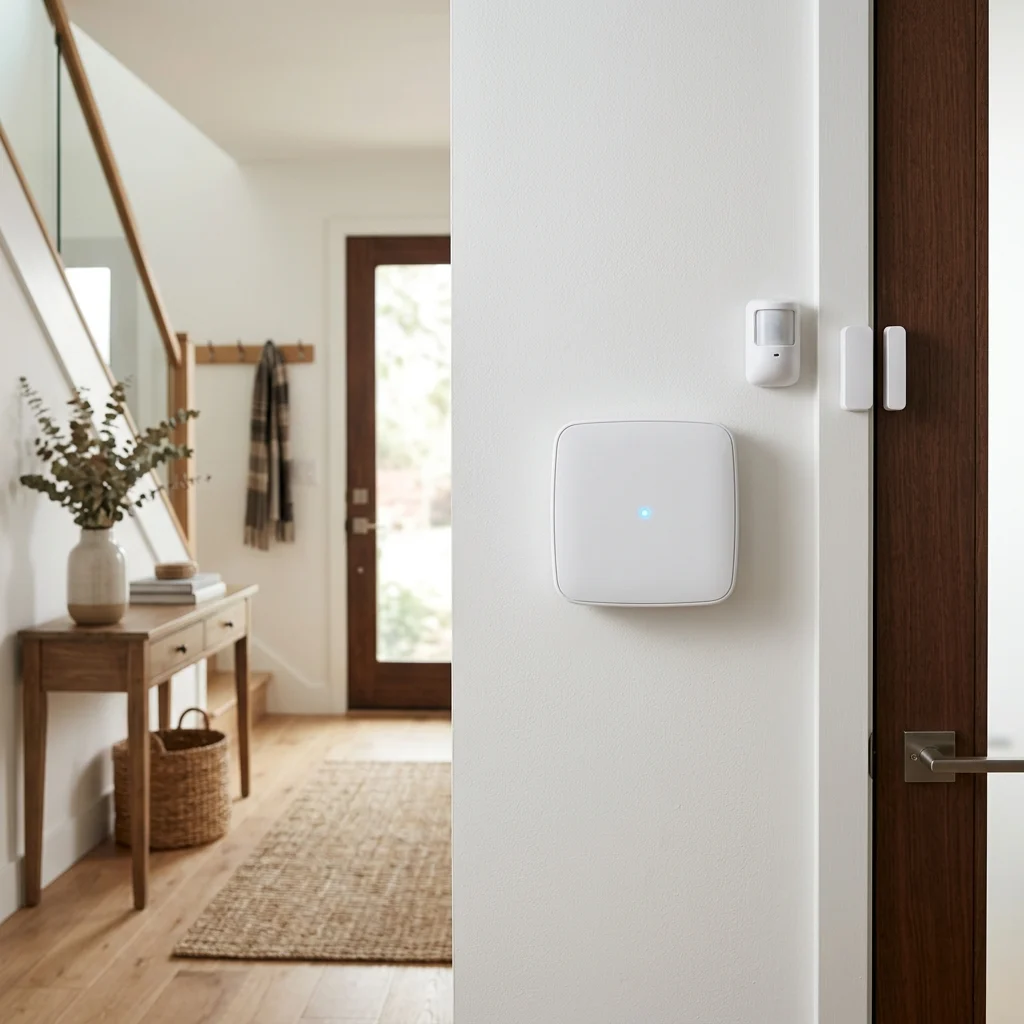
Walk into any security trade show today and the trend is unmistakable: wireless alarm systems are taking over. Panels that once required dozens of wire runs through walls, attics, and ceilings are being replaced by compact hubs that communicate with their sensors entirely over radio frequency. For property owners — residential and commercial — this shift promises faster installation, less disruption, and easier expansion. But not all wireless systems are built the same, and the details that separate a genuinely reliable system from a problematic one are rarely explained in marketing brochures.
This guide covers what "wireless" actually means in an alarm context, how the major radio protocols differ, what the real-world maintenance looks like, and when hardwired still makes more sense.
What "Wireless" Actually Means in an Alarm System
The word "wireless" in alarm marketing can refer to two entirely different communication links, and it's important to understand the distinction.
The first link is sensor-to-panel: this is how the door contacts, motion detectors, glass-break sensors, and smoke detectors talk to the central hub. In a wireless system, these devices use a radio frequency (RF) protocol instead of physical wires. This is the part that eliminates the need to run cable through your walls.
The second link is panel-to-monitoring station: this is how the panel communicates an alarm event to the central monitoring station that dispatches police or fire. This link can be a landline (POTS), an internet (IP) connection, or a cellular (LTE/4G) connection — or a combination of these as redundancy.
A system can be wireless in one sense but not the other. Some panels use wireless sensors but rely on a hardwired internet connection to reach the monitoring station. Others — like systems from Ajax Systems — are wireless on both links: sensors communicate to the hub via RF, and the hub communicates to the monitoring station via LTE, with Wi-Fi and Ethernet as backup paths. Understanding which links are wireless in any given system is the first step to evaluating its actual resilience.
Radio Protocols: Not All Wireless Is Equal
The radio protocol a system uses determines its range, reliability, security, and resistance to interference. This is arguably the most important technical differentiator between wireless alarm platforms, and it's rarely discussed at the consumer level.
- 433 MHz (Legacy): Many older or budget wireless alarm systems operate on the 433 MHz band with basic encoding. These systems are functional but typically lack encryption, have limited range, and are vulnerable to replay attacks — where a recorded signal is retransmitted to fool the panel. If a system does not specify its protocol, it is often using a variant of this legacy approach.
- Z-Wave / Zigbee: Common in home automation ecosystems (SmartThings, Hubitat). These protocols are designed for smart home devices — light switches, thermostats, locks — and some alarm panels incorporate them for sensor communication. They work well for automation but were not originally designed for security-grade intrusion detection, and their mesh-network architecture can introduce latency.
- PowerG (DSC / Johnson Controls): A professional-grade protocol used in DSC's PowerSeries Pro and Qolsys IQ Panel platforms. PowerG uses 128-bit AES encryption, frequency hopping spread spectrum (FHSS), and two-way communication with adaptive transmission power. It offers up to 2 km open-air range and is widely deployed in North American professional installations.
- Jeweller (Ajax Systems): Ajax's proprietary protocol, developed specifically for alarm applications. Jeweller operates on multiple frequency bands simultaneously, uses AES encryption, and performs over 36,000 status checks per hour per device (a "supervision heartbeat" roughly every 12–300 seconds depending on configuration). Its range extends up to 2 km in open air, and the protocol includes built-in jamming detection that alerts the monitoring station if RF interference is detected on any band.
- SiX (Honeywell / Resideo): Used in the Lyric and ProSeries platforms. SiX uses 128-bit AES encryption and FHSS across 80+ channels. It's a two-way protocol with over-the-air firmware updates for sensors — a feature that avoids the need to physically access each sensor for software patches.
The key specifications to compare across any protocol are: encryption standard (AES-128 or AES-256 is the current baseline), two-way communication (the panel confirms receipt of every sensor signal, not just one-way transmission), frequency hopping (changes channels rapidly to avoid interference), and supervision interval (how frequently the panel verifies each sensor is still online and untampered).
Cellular vs. Internet vs. Landline: How the Panel Reaches the Monitoring Station
The communication path between the alarm panel and the monitoring station is the system's lifeline. If that path is cut — whether by a severed phone line, a downed internet connection, or a cellular outage — the alarm can sound locally but no one is dispatched.
Landline (POTS): The legacy standard. Alarm signals are transmitted as audio tones over a telephone line using protocols like Contact ID or SIA. Landlines are increasingly being decommissioned by Canadian telecom providers, and the physical copper wire is trivially easy to cut at the exterior of a building. New installations should avoid landline-only communication.
IP (Internet): The panel connects to the monitoring station over the property's internet connection. Faster than landline and supports higher-bandwidth features like video verification. The vulnerability is shared: if the internet goes down — whether from an ISP outage, a router failure, or someone unplugging the modem — the alarm path goes with it.
Cellular (LTE/4G): The panel contains its own SIM card and communicates directly over the cellular network, independent of the property's internet and phone service. This is the most resilient single-path option. Systems built around cellular-first communication — like Ajax hubs, which use dual-SIM LTE as the primary path — are not affected by local internet or power infrastructure issues (assuming the panel has battery backup).
The most robust configuration is dual-path: cellular as the primary channel with IP as a secondary, or vice versa. If one path fails, the other takes over automatically. Most professional-grade panels from DSC (via the TL280/TL405 communicators), Honeywell (AlarmNet), and Ajax (built-in dual-SIM + Ethernet) support this configuration.
Battery Life and Maintenance Realities
"Wireless" eliminates cable runs, but it does not eliminate maintenance. Every wireless sensor is powered by a battery — typically a CR123A lithium cell — and that battery has a finite lifespan.
Manufacturer claims for battery life typically range from 3 to 7 years, depending on the device type, the supervision interval, the RF protocol's power efficiency, and environmental conditions. In practice, sensors in high-traffic areas (a front door contact that triggers 30+ times per day) will deplete faster than a motion sensor in a storage room that activates twice a week.
A well-designed wireless system handles low batteries gracefully. The panel should generate a low-battery alert weeks before actual failure, giving the property owner or monitoring company time to replace the cell. The system should also perform supervision checks — periodic heartbeats between each sensor and the panel — and alert immediately if any device stops responding. If a sensor goes offline silently and the panel does not notice, that is a design flaw, not a dead battery.
Property owners should expect to replace sensor batteries on a rolling basis, roughly 15–20% of sensors per year once the system passes the three-year mark. This is a minor cost (a CR123A cell costs approximately $3–$5) but it does require access to each sensor, which may involve ladders for ceiling-mounted motion detectors. Some installers offer annual maintenance contracts that include battery replacement as part of a scheduled service visit.
The Jamming and Interference Question
A common concern with wireless alarm systems is jamming: can someone use a radio-frequency jammer to block sensor communication and defeat the system?
The short answer is that RF jamming is technically possible but practically difficult against a well-designed modern system. Legacy 433 MHz systems operating on a single fixed frequency are the most vulnerable — a simple broadband noise generator can overwhelm the signal. However, current professional-grade protocols have made this significantly harder.
Frequency hopping means the system rapidly switches between dozens or hundreds of channels. A jammer would need to flood the entire frequency band, not just one channel, which requires significantly more power and a more sophisticated (and more illegal, more detectable) device.
Jam detection is the more important defence. Systems using Jeweller, PowerG, and SiX protocols actively monitor the RF environment. If sustained interference is detected on the communication band, the panel generates a "jamming detected" alert and transmits it to the monitoring station via its cellular or IP backup path — the very path the jammer is not targeting. This means the monitoring station knows something is wrong even if individual sensor signals are being blocked.
In practice, documented cases of RF jamming being used in residential or commercial burglaries in Canada remain rare. The far more common attack vector is still physical: cutting a phone line or disabling an internet router. Cellular-first panels with battery backup address this vulnerability more directly than any anti-jamming feature.
When Hardwired Still Makes More Sense
Wireless is not universally superior. There are scenarios where a hardwired alarm system remains the better engineering choice.
- New construction with open walls: If the building is under construction or undergoing a major renovation with exposed framing, running wire is trivial and adds zero visual disruption. In this scenario, hardwired sensors eliminate battery dependency entirely and are marginally more tamper-resistant.
- High-security environments: Banks, cannabis retail locations, jewellery stores, and pharmaceutical storage facilities are often required by insurance or regulation to use hardwired systems. The reasoning is that hardwired sensors have no RF signal to intercept or disrupt, and the physical cable connection provides an additional layer of tamper detection.
- Very large installations (50+ zones): Systems with a large number of sensors — common in multi-floor commercial buildings — can strain wireless protocol capacity and create RF congestion, particularly if the building has dense metal framing or concrete partition walls. Hardwired or hybrid architectures (wireless sensors communicating to hardwired zone expanders) scale more predictably in these environments.
- Environments with extreme RF interference: Industrial facilities with heavy machinery, MRI suites in medical buildings, or properties adjacent to broadcast towers can generate ambient RF noise that degrades wireless sensor performance. A site survey with an RF spectrum analyser can identify these conditions before installation.
Many modern panels support hybrid configurations — a mix of hardwired and wireless zones on the same system. This allows property owners to run wire where it's practical (a ground-floor perimeter during a renovation, for example) and deploy wireless sensors in areas where cabling would be disruptive or cost-prohibitive (a finished second floor, a detached garage, an outbuilding).
Choosing a System That Doesn't Lock You In
One of the most consequential decisions in choosing an alarm system has nothing to do with the technology itself — it's whether the system can be serviced by someone other than the original installer.
Some alarm platforms are "dealer-locked," meaning the installer who programs the panel retains exclusive access to the system configuration. If the relationship with that installer deteriorates, or if the company goes out of business, the property owner may be unable to change monitoring providers, update zone programming, or add new sensors without a complete panel replacement.
Systems from manufacturers like DSC, Honeywell, and Ajax are generally open-architecture — any qualified technician with the appropriate credentials can access the programming, transfer the system to a new monitoring provider, or take over service. This is a significant long-term advantage, particularly for commercial properties where the security system may outlast the original installation contract by a decade or more.
Before signing any contract, ask explicitly: "If I want to switch installers or monitoring providers in two years, can I do so without replacing the panel?" The answer to that question reveals more about the system's long-term value than any spec sheet.
Making the Decision
Wireless alarm technology has matured to the point where it is a genuinely reliable option for the majority of residential and commercial intrusion detection applications. The protocols used by current professional-grade systems — encrypted, frequency-hopping, two-way supervised — are a fundamentally different category from the basic RF sensors of a decade ago.
When evaluating a wireless system, focus on the specifics: What protocol do the sensors use? Is the panel-to-station path cellular, IP, or both? What is the supervision interval? How does the system handle jamming detection? Can the system be transferred to another installer? These are the questions that determine whether a system is genuinely robust or simply convenient.
The right choice depends on the property, the risk profile, and the construction conditions — not on whether "wireless" or "wired" sounds better in a brochure. A qualified installer who asks detailed questions about your specific situation before recommending equipment is a better starting point than any product comparison chart.