Consumer Cameras vs. Professional CCTV: An Honest Comparison
Ring, Nest, and Arlo have done something genuinely useful: they've made it easy to put a camera above your front door. For a lot of people, that's exactly what they need. But "I want to see who's at my porch" and "I need documented evidence if something goes wrong" are different problems — and the equipment that solves one doesn't necessarily solve the other.
This isn't an argument that consumer cameras are bad. It's an attempt to explain what the differences actually are, so you can make an informed decision about which category of equipment fits your situation.
Resolution and the Pixels Per Foot Standard
Most Ring and Nest cameras capture at 1080p. Some newer models offer 1080p HDR or a slightly higher resolution. Professional-grade IP cameras typically start at 4MP and go up to 4K (8MP) or higher for specialized applications.
Raw resolution matters less than how that resolution is distributed across the scene. A 1080p camera pointed at a wide driveway will have very little detail at the far end — the image is stretched across too large an area. The security industry uses a measurement called Pixels Per Foot (PPF) to quantify this. For a camera to produce footage usable for facial identification, the general standard is 40 PPF or higher at the target distance. For licence plate capture, 50+ PPF is typical.
A 1080p wide-angle consumer camera at 15 feet often delivers 20–30 PPF at the perimeter of its view. In practice, a person's face at that distance might be 80–100 pixels wide — not enough for confident identification. This is the core reason consumer camera footage frequently can't be used for police investigations, even when the camera was technically recording during an incident.
Night Vision: Why Black and White Matters
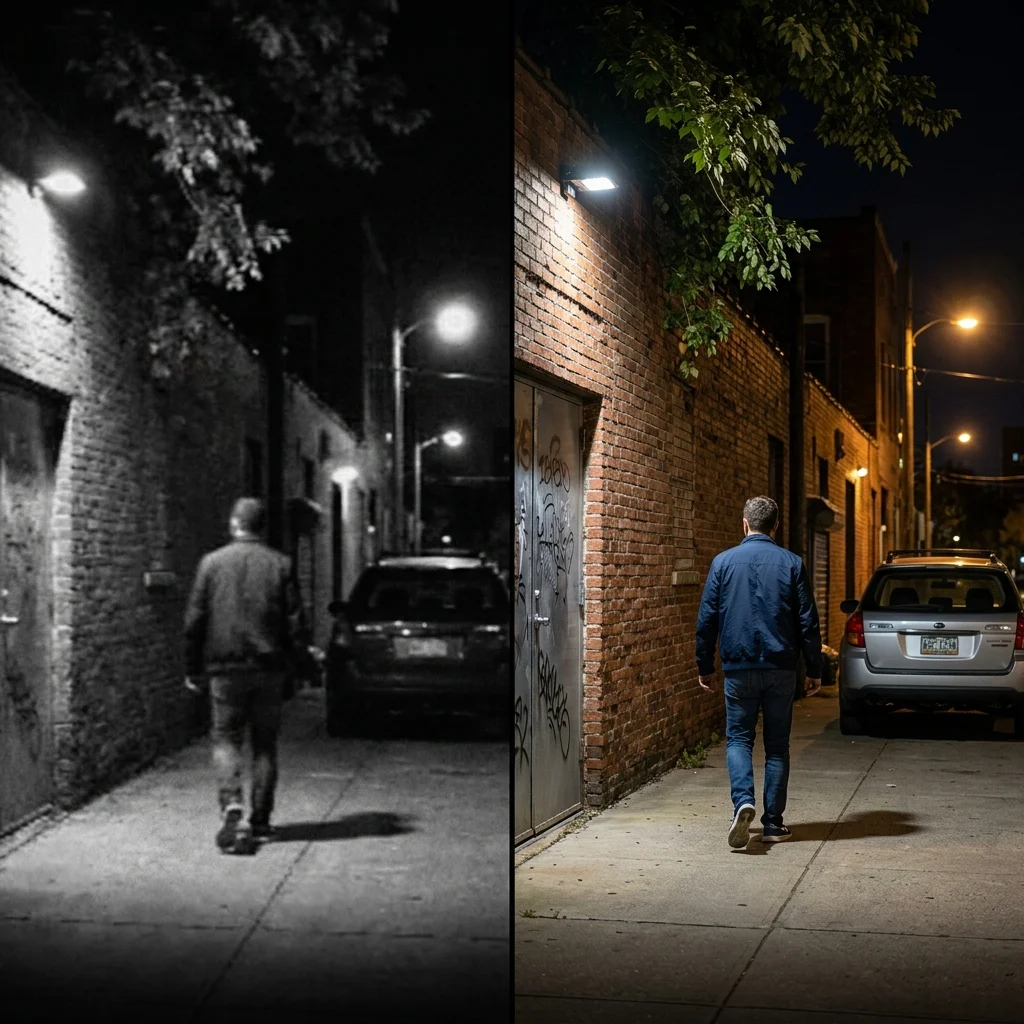
Consumer cameras almost universally use infrared (IR) night vision. When ambient light drops below a threshold, an IR cut filter flips in front of the sensor, the IR LEDs activate, and the camera switches to greyscale. The range is typically 5–10 metres for meaningful detail.
The limitation isn't just range — it's information loss. Greyscale footage eliminates clothing colour, hair colour, and vehicle colour from the recorded image. These are often the most immediately useful descriptors when speaking to police or reviewing footage after an incident.
Commercial-grade cameras have addressed this through full-color low-light technology. Hikvision's ColorVu line, Dahua's Full-color cameras, and similar products from Hanwha and Axis use larger image sensors and wider apertures (typically f/1.0–f/1.6) that collect enough ambient light to maintain colour at night without IR. These cameras continue recording colour footage in conditions that would push a consumer camera into greyscale.
It's worth noting that "colour night vision" marketed on some consumer products often just means the camera adds a white spotlight LED — which illuminates the scene but also alerts anyone in front of it that they're being recorded. Full-spectrum low-light sensors are a different technology.
WiFi Reliability and the Jamming Risk
Consumer cameras are wireless by design. This is what makes them easy to install — no cables, just power and WiFi. The tradeoff is that they inherit all the reliability and security limitations of a WiFi connection.
The reliability issue is straightforward: if your router reboots, your internet drops, or the camera moves out of range, it stops recording. Many consumer cameras also store footage in the cloud — meaning a connectivity gap creates a gap in the recording history.
The security issue is less well known but documented: WiFi deauthentication attacks, sometimes called jamming, involve flooding the 2.4GHz or 5GHz band with deauthentication packets to knock wireless devices offline. This doesn't require sophisticated equipment — commercial deauthers exist, and the technique has been observed in break-in investigations. Every WiFi camera in range goes dark simultaneously and silently, with no alert generated, because the device itself believes it simply lost signal.
Hardwired PoE (Power over Ethernet) cameras are not vulnerable to this attack. Data travels over a physical cable; there is no wireless signal to disrupt. The cable itself can be targeted physically, which is why professional installations typically route cable through conduit in exposed areas.
Coverage Design vs. Camera Placement
Consumer cameras are sold with the assumption that the buyer places them. The manufacturer provides a general guideline — "point it at your front door" — and the rest is intuition.
Professional camera placement follows a structured process. A site survey maps the property's choke points — the locations where anyone entering or exiting must pass — and calculates the required focal length for each camera position to achieve the target PPF at that distance. Lighting conditions at different times of day and season are assessed. Overlapping fields of view are planned to eliminate gaps. This is security design, not just camera mounting.
The result is that a well-designed 4-camera professional system will often cover a property more thoroughly than a self-installed 8-camera consumer system, because the professional system was designed around coverage requirements rather than around camera count.
Storage: Cloud Subscriptions vs. Local NVR
Most consumer camera systems store footage in the cloud on a rolling basis — Ring's Protect plan, Google Home's subscription, and similar. This means a monthly recurring cost, a dependency on connectivity, and footage that lives on a third-party server.
Professional IP camera systems typically record to a local Network Video Recorder (NVR). Footage is stored on-site on hard drives, with retention calculated based on drive capacity, resolution, and frame rate. A 4-camera 4K system recording continuously might store 15–20 days on a 4TB drive. There's no monthly fee, no connectivity dependency, and no footage on external servers.
Whether local or cloud storage is preferable depends on your situation. Cloud storage is accessible remotely without VPN configuration, and footage survives if the camera itself is stolen. Local storage is cheaper long-term, private, and doesn't create a gap if internet goes down. Many commercial systems use both — local NVR for primary storage with cloud backup for critical events.
When Consumer Cameras Are the Right Answer
Consumer cameras make sense when the goal is awareness — knowing when a package arrives, seeing who's at the door, checking in on the house while travelling. They're easy to set up, easy to move, and inexpensive enough that adding several is practical. For renters, for small apartments, or for supplementing a larger system with additional angles, they're a reasonable tool.
Where they fall short is when the footage needs to serve as evidence, when the property faces a genuine security risk, or when the system needs to function reliably regardless of network conditions. At that point, the limitations of consumer hardware — resolution, night vision, wireless vulnerability, and cloud dependency — become meaningful rather than theoretical.
The decision isn't really "consumer vs. professional." It's "what are you actually trying to accomplish, and what does that require?" The answer to that question usually makes the equipment choice fairly clear.